






Ayele Addis Ambelu (Investigative Story)
Human rights violations in Africa remain a persistent crisis, affecting millions across the continent. While progress has been made in legislative frameworks and regional policies, deep-rooted issues such as political repression, armed conflicts, gender-based violence, and environmental degradation continue to undermine fundamental freedoms. This article delves into the complexities of Africa’s human rights landscape, exploring research findings, expert opinions, case studies, and statistical insights, and proposes actionable solutions to strengthen human rights protections.
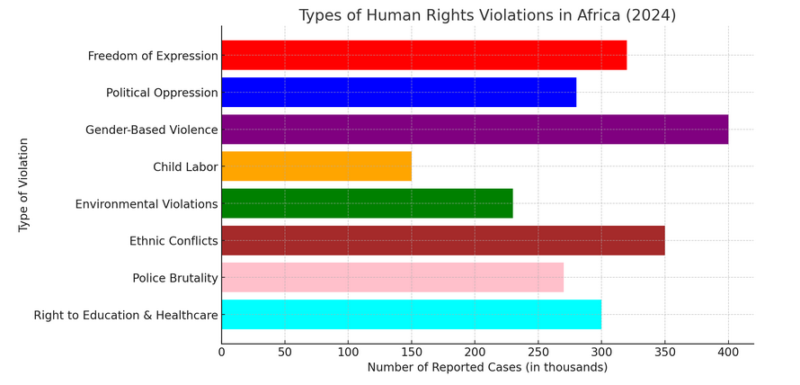
Types of Human Rights Violations in Africa
Africa faces numerous human rights abuses, including but not limited to:
- Freedom of Expression and Press Repression – Journalists and activists face censorship, harassment, and imprisonment. Countries like Ethiopia, Sudan, and Uganda have seen increasing crackdowns on media freedom (Amnesty International, 2023).
- Political Oppression and Arbitrary Detention – Governments in Zimbabwe, Egypt, and Cameroon have been accused of imprisoning opposition leaders and activists (Human Rights Watch, 2024).
- Gender-Based Violence (GBV) – In conflict zones like the Democratic Republic of Congo (DRC), rape has been weaponized against women and girls (UNHCR, 2023).
- Child Labor and Exploitation – Forced labor in agriculture and mining industries is rampant in Ghana, Mali, and Côte d’Ivoire (ILO, 2023).
- Environmental Rights Violations – Industrial pollution and deforestation threaten indigenous communities, particularly in Nigeria’s Niger Delta and Madagascar (World Bank, 2024).
Sensational Cases Highlighting Human Rights Violations
One of the most shocking cases in recent years was the EndSARS protests in Nigeria (2020), where police brutality led to mass killings of civilians. Amnesty International reported that at least 56 people were killed in nationwide protests, including the infamous Lekki Toll Gate massacre (Amnesty International, 2020).
Another devastating case occurred in Ethiopia’s Tigray region, where thousands of civilians were massacred, and mass sexual violence was reported during the war between government forces and the Tigray People’s Liberation Front (TPLF) (BBC, 2022).
Research Findings on Human Rights Violations
Several research studies and reports highlight the severity of Africa’s human rights challenges:
- Amnesty International 2023 Report – Found that 32 African countries have restrictive laws against freedom of assembly and expression.
- Human Rights Watch Report on Nigeria (2024) – Documented over 1,200 extrajudicial killings in 2023 alone.
- UNHCR Data on Refugees – Over 44 million Africans are displaced due to conflicts and persecution, making up nearly 30% of the global refugee population.
Expert Interviews: Voices from the Frontline
Dr. Solomon Ayele Dersso, a human rights legal expert, emphasizes, “The lack of enforcement mechanisms within the African Union’s human rights bodies weakens the impact of treaties and protocols. Countries sign agreements but fail to implement them.”
Tiseke Kasambala, a senior researcher at Human Rights Watch, states, “Press freedom is under siege. Governments across Africa are increasingly targeting journalists who expose corruption and abuse.”
Prof. Grace Nyongesa, a gender rights activist, remarks, “Without cultural shifts and legal enforcement, gender-based violence will persist. We need community engagement alongside policy reforms.”
Causes of Human Rights Violations
The underlying causes of Africa’s human rights crises include:
- Weak Legal and Institutional Frameworks – Poor enforcement of laws allows violations to persist.
- Corrupt Governance – Many governments use human rights abuses to consolidate power.
- Economic Inequality – Poverty drives forced labor, exploitation, and lack of access to basic rights.
Effects of Human Rights Violations
The repercussions of unchecked human rights abuses are devastating:
- Mass Displacement and Refugee Crises – Wars and oppression force millions into refugee camps.
- Economic Decline – Countries with severe human rights abuses deter investment and economic growth.
- Social Unrest and Revolutions – Civil uprisings become inevitable when rights are continuously suppressed.
Solutions and Recommendations
1. Strengthening Legal Frameworks and Enforcement – The African Court on Human and Peoples’ Rights must be empowered with stronger enforcement mechanisms.
2. Supporting Press Freedom and Civil Society – Governments must cease attacks on journalists and activists, ensuring protections for whistleblowers.
3. Economic and Social Development Programs – Investing in education, job creation, and social services will alleviate poverty-driven human rights abuses.
4. Corporate Accountability – Stricter regulations for African multinational companies to prevent labor and environmental exploitation.
Conclusion
Africa’s human rights struggle is far from over, but concerted efforts from governments, civil society, and international actors can bring meaningful change. Justice, freedom, and dignity must remain at the forefront of the continent’s development agenda. Without accountability and sustained advocacy, the cycle of violations will persist.
Hashtags:
#HumanRightsAfrica #PressFreedom #JusticeForAll #EndGBV #AfricanUnion #FreedomOfSpeech #StopChildLabor #RightToEducation #EnvironmentalJustice #EndPoliceBrutality #GenderEquality #RefugeeRights








