





By NEBIYU Y. TEKLIE : Africaunionmedia@gmail.com
In Ethiopia, a nation marked by political unrest and vibrant diversity, the state of public media reflects a troubling paradox. While these outlets have the potential to inform and empower citizens, they are increasingly seen as disconnected from the public they are meant to serve. This growing perception of failure raises fundamental questions about state-controlled media’s role, purpose, and integrity in times of national crisis.
Voices from the Ground
Ayaleu Tesema, a resident of Gondar, typifies the frustrations many Ethiopians feel. Despite regularly tuning into local radio and television stations, He questions why critical events—such as gunfire in his city—are conspicuously absent from coverage. “If they don’t tell us our truth, why should we consider them ours?” he asks, highlighting the emotional disconnect between the public and the media they fund through taxes.
Similarly, Tigist Benti, from Nekemte, shares her disillusionment. Her city has endured relentless violence between government forces and militants, yet local public media outlets have failed to report these events. “It feels like a deliberate denial of our reality,” she laments. Both individuals have turned to external sources, such as Voice of America, for critical updates—a damning indictment of Ethiopian public media’s relevance and credibility.
Inside the Media: A Journalist’s Perspective
A journalist working within state media, speaking on condition of anonymity, sheds light on the systemic issues plaguing the sector. “Working here, especially during crises, makes you hate your profession,” they admit. The journalist describes an oppressive environment where reporting even the existence of a conflict requires political approval. As a result, crucial issues—from human rights violations to armed clashes—are routinely ignored or delayed.
“There’s no leadership willing to stand up for public accountability,” the journalist adds. Instead, coverage often serves as a reactionary tool, defending government actions after external outlets expose them. This reactive posture, they argue, further erodes public trust and undermines journalism’s role as a watchdog for society.
Structural and Policy Constraints
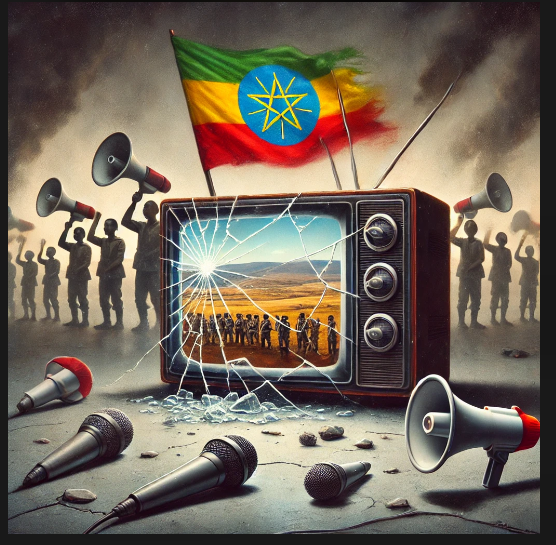
A visual representation capturing the symbolic failure of Ethiopian public media. The shattered television and muted microphones reflect the untold stories and censorship, while the faded flag and shadows evoke the societal tension underlying the media’s silence.
Dr. Ayele, a professor of journalism and communication, warns that this silence is accelerating the decline of public media in Ethiopia. “In the digital age, where information spreads rapidly, ignoring significant issues only damages credibility and competitiveness,” he explains. Ethiopian public media risks being eclipsed by alternative sources, including international broadcasters and social media, by failing to adapt.
Government policies exacerbate this decline. The 2021 Media Decree, initially lauded for promoting media self-regulation, has been undermined by subsequent amendments. Recent changes grant the Prime Minister authority to appoint the Director General of the Media Authority, removing transparency requirements for board appointments. Critics, including 14 civil society organizations, argue that these revisions consolidate government control and stifle independent journalism.
Dr. Legesse Tulu, Ethiopia’s Minister of Communication, openly defends the government’s influence over public media. At a media leadership training session, he emphasized that state-funded outlets must align with government priorities. “You are government employees,” he stated. “You cannot criticize the government’s policies and performances.”
Public Media in Crisis
The Ethiopian Media Authority oversees 51 public radio stations and 28 television channels. However, their collective failure to address public concerns has sparked widespread disillusionment. Opposition parties, such as Ethiopian Citizens for Social Justice (EZEMA), have accused the government of turning media institutions into propaganda tools. “The media must foster dialogue and help Ethiopia escape its cycle of conflict,” EZEMA declared in a recent statement.
International watchdogs echo this criticism. Reports from organizations like Freedom House and the Committee to Protect Journalists highlight Ethiopia’s regression in press freedom. The proposed amendments to the Media Act are viewed as a direct threat to journalistic independence, raising fears of further censorship.
The Path Forward
Restoring trust in Ethiopian public media requires bold reforms. Experts suggest the following steps:
- Independent Oversight: Establish a genuinely autonomous regulatory body to oversee media operations and ensure accountability.
- Transparency in Governance: Reinstate transparent processes for board appointments and decision-making within the Ethiopian Media Authority.
- Empowering Journalists: Protect journalists from political interference, enabling them to report freely and fairly on critical issues.
- Engaging with Citizens: Public media must prioritize local concerns, providing timely and accurate coverage of events that matter most to communities.
Conclusion
The Ethiopian public media landscape is at a crossroads. As citizens increasingly rely on external sources for critical information, the relevance and credibility of state-controlled outlets continue to erode. Without urgent reforms, these institutions risk permanent marginalization in the digital information age. Ethiopian public media can only reclaim its role as a trusted voice for the nation by recommitting to its foundational mission—to inform, educate, and empower.








