





From Antalya to Africa: As world leaders prepare to gather for the United Nations Climate Change Conference, the battle over fossil fuels, climate finance, adaptation, ocean protection and climate justice is exposing the widening gap between political promises and the survival needs of millions.
By Ayele Addis Ambelu, Africa News Channe | 8 NOVEMBER 2026 , EARTH JOURNALISM NETWORK | COP31 SPECIAL COVERAGE
Tomorrow, the world will once again assemble around a familiar diplomatic table, carrying an increasingly uncomfortable question: how many more climate conferences will it take before the world starts delivering what it has repeatedly promised?
From drought-stricken African communities and disappearing glaciers to rising oceans, burning forests, expanding coal mines and increasingly vulnerable cities, the climate crisis is no longer a distant environmental warning. It is a present-day economic, humanitarian, developmental and political emergency.
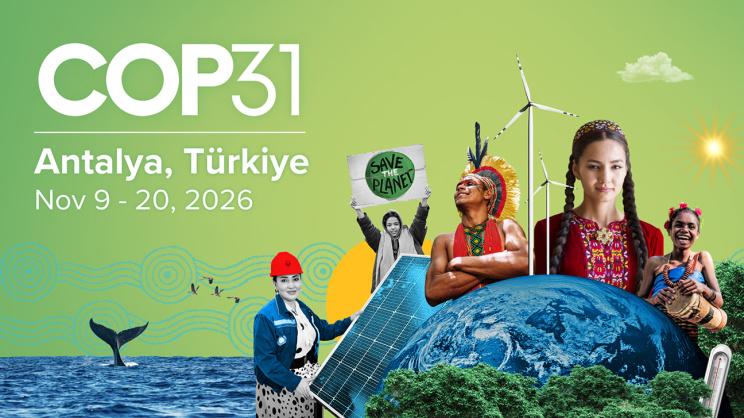
On 9 November, Antalya, Türkiye, becomes the centre of global climate diplomacy as the 31st Conference of the Parties to the United Nations Framework Convention on Climate Change (COP31) opens its doors for twelve days of negotiations, political declarations, scientific discussions and international climate partnerships, running until 20 November 2026.
But COP31 arrives at a moment when the credibility of international climate cooperation faces a fundamental test: the world is not short of climate commitments; it is short of implementation, accessible finance, accountability and political courage.
The stakes are enormous. Nearly 197 parties are expected to participate, with approximately 100,000 participants anticipated. Türkiye will host the conference and lead its Action Agenda, while Australia will lead the formal negotiations. The World Leaders Climate Action Summit is scheduled for 11–12 November.
The conference’s twelve thematic days will address everything from food security, energy and transport to finance, youth, oceans, gender, technology and final negotiations. Ultimately, the real measure of COP31 will not be the number of sessions held, declarations announced or leaders photographed. It will be whether those discussions produce measurable changes in the lives of people already confronting climate disruption.
The climate finance paradox: The world knows what is needed, but where is the money?
However, UNEP issues one of the most urgent warnings with its 2026 Adaptation Gap Report, revealing a staggering funding imbalance. However, it reveals a staggering imbalance between resources and the cost of protecting populations from climate impacts.
However, international public adaptation finance from developed to developing countries reached approximately US$28.2–31.7 billion in 2024. Nevertheless, developing countries will require an estimated US$305 billion annually by 2035 to meet their adaptation needs.
Even if the international commitment to triple adaptation finance by 2035 is achieved, UNEP estimates that it would cover only 20–29% of the projected requirements. However, it would still cover only 20–29% of the projected requirements.
This is more than a financial discrepancy. Moreover, this involves climate justice.
Developing countries, many of which have contributed relatively little to historical greenhouse gas emissions, are being forced to spend increasingly scarce public resources on drought response, flood recovery, food security, infrastructure protection and disaster preparedness.
UNEP Executive Director Inger Andersen delivered a particularly powerful warning:
“The world is not ready to adapt to current climactic conditions, never mind what overshoot of 1.5°C will bring.”
UNEP – UN Environment Programme
For Africa, this warning carries immediate significance. The continent’s climate vulnerability is colliding with development challenges, limited fiscal capacity, agricultural dependence and unequal access to international climate finance.
The question facing COP31 is therefore not simply how much money governments announce. It is whether that money will be new, predictable, accessible, affordable and available to the communities that need it.
The fossil fuel contradiction: Climate leadership versus coal dependence
Even before the conference officially opens, Türkiye is facing a powerful contradiction between its international climate ambitions and the environmental realities within its own borders.
A Reuters investigation published on 8 November reports that residents of İkizköy, near the Akbelen forest in southwestern Türkiye, are urging visiting world leaders to leave the conference venue and witness the consequences of decades of lignite coal mining.
Coal generated 34% of Türkiye’s electricity in 2025, according to energy think tank Ember, making the country Europe’s largest coal-fired electricity producer.
Local community representative Nejla Isik told:
“They should come here, those heads of state. They should come not to Antalya but to Akbelen, to Ikizkoy.”
She also described the community’s experience:
“For 40 years we’ve been living with coal breathing down our necks.”
The story raises a fundamental question about the credibility of climate leadership: can a country champion global electrification while communities continue to experience the environmental and social costs of coal extraction?
It also highlights the importance of protecting environmental defenders, journalists and civil society organisations participating in climate discussions.
The contradiction is not limited to Türkiye. It reflects a wider global challenge: the transition to clean energy must be accompanied by real reductions in fossil fuel dependence, protection of affected communities and a just transition for workers.
Africa arrives at COP31 with a demand: Climate justice must move from promises to delivery
For Africa, COP31 is not simply another international climate conference. It is an opportunity to challenge the unequal distribution of climate responsibilities, resources and decision-making power.
The African Group of Negotiators (AGN), chaired by Ghana’s Nana Dr. Antwi-Boasiako Amoah, is entering the negotiations with priorities that include tripling adaptation finance, replenishing the Green Climate Fund, strengthening loss-and-damage arrangements and securing fairer climate-related trade arrangements.
The AGN’s position is particularly important because African countries have repeatedly faced difficulties implementing their Nationally Determined Contributions (NDCs) and National Adaptation Plans because of financial and institutional constraints.
Speaking ahead of the conference, the AGN chair posed a question that captures the continent’s frustration:
“Where is the financial ambition to help developing countries implement those commitments in their national adaptation plans?”
He further argued:
“We need to make sure that we lay the building blocks so solidly to be able to go into COP32 with more strength.”
These statements carry additional significance because COP32 is scheduled to take place in Ethiopia in 2027, presenting an opportunity for Africa to strengthen its collective negotiating position.
The African Development Bank, African Union Commission, UN Economic Commission for Africa and AUDA-NEPAD are among the institutions supporting the Africa Pavilion at COP31.
The pavilion will showcase African priorities, including climate finance, food security, adaptation, loss and damage, green industrialisation, renewable energy, critical minerals, technology and youth-led innovation. uneca.org
The central question for African journalists is whether the continent will be treated as an equal partner in shaping global climate policy or remain primarily a recipient of climate assistance.
Africa has substantial renewable energy resources, biodiversity, forests, mineral wealth and a young population. Yet these opportunities cannot be translated into sustainable development without investment, technology transfer, institutional capacity and fair access to climate finance.
For Ethiopia and other African countries, the discussions should be examined through a development lens: climate resilience must protect livelihoods, strengthen agricultural productivity, expand clean energy access and create decent employment.
Oceans: The missing frontline in the climate negotiations
While much of the global climate conversation focuses on emissions, energy and land use, the oceans remain one of the most important and insufficiently integrated parts of the climate response.
The COP31 Ocean Virtual Reporting Fellowship briefing supplied with this assignment identifies three central areas to monitor:
- Whether countries integrate ocean action into their NDCs and national policies.
- Whether finance for ocean protection becomes more predictable and accessible.
- Whether oceans receive stronger recognition within the Paris Agreement architecture.
The briefing also identifies offshore renewable energy, cleaner maritime transport, methane reduction, ocean conservation and coastal resilience as important areas of action.
More than 100 countries are reportedly seeking stronger integration of ocean issues into the Paris Agreement architecture. Türkiye is also working on an Antalya Oceans Declaration and a proposed Blue Package.
These developments deserve scrutiny because the ocean is simultaneously a climate regulator, a source of food and livelihoods, a biodiversity reservoir and a foundation of economic activity for millions of people.
The crucial question is whether COP31 can move beyond recognising the importance of the ocean and establish concrete financing and implementation mechanisms.
The proposed annual ocean investment gap of approximately US$540 billion and the claim that only 2% has been delivered appear in the supplied fellowship briefing. They should be attributed to that briefing until the underlying financial methodology and primary sources are independently checked.
The 1.5°C warning: Science must not become another political casualty
Climate science will be another major battleground in Antalya.
The World Meteorological Organization (WMO) has announced that it will place scientific observation and early warning systems at the centre of its COP31 engagement.
Its State of the Climate Update 2026 is scheduled for 9 November and will address key indicators, including global temperatures, greenhouse gas concentrations, ocean heat, sea levels, glaciers and climate-related extreme events. World Meteorological Organization+1
This matters because the international climate debate increasingly concerns not only the commitments countries are prepared to make, but also the scientific evidence governments are willing to acknowledge.
The central challenge is to ensure that scientific findings inform national policies, investment decisions and the protection of vulnerable populations.
A particularly important reporting question is whether governments will respond to the scientific evidence with stronger emissions reductions, effective adaptation strategies and transparent accountability.
Twelve days, twelve priorities: What should the world expect?
The COP31 Presidency has organised twelve thematic days to connect political dialogue with practical climate solutions.
| Date | Thematic priority | Major reporting question |
|---|---|---|
| 9 Nov | Food, Agriculture and Health | Who will finance climate-resilient food systems? |
| 10 Nov | Energy and Transport | Can electrification accelerate without clean energy supply? |
| 11 Nov | Zero Waste / Leaders Summit | Will resource efficiency produce measurable commitments? |
| 12 Nov | Resilient Cities / Leaders Summit | How will cities finance climate resilience? |
| 13 Nov | Finance and Trade | Who pays, who receives and on what terms? |
| 14 Nov | Children, Youth, Education and Skills | Will young people influence decisions or simply attend? |
| 15 Nov | A Breath in Antalya | How do culture and society shape climate action? |
| 16 Nov | Science, Industry and Technology | Can innovation accelerate decarbonisation? |
| 17 Nov | Ocean, Seas, Nature and Land Use | Will ocean protection receive real financing? |
| 18 Nov | Human and Social Development / Gender | Who is being left behind in the transition? |
| 19 Nov | İmece: Enhancing Implementation | Will commitments become investment-ready projects? |
| 20 Nov | Final Negotiations | What has actually been agreed? |
- he briefing also highlights an important statement from AGN Chair Nana Dr. Antwi-Boasiako Amoah:
“Antalya must be defined by delivery rather than another cycle of unfulfilled promises.”
This story was produced as part of the COP31 Climate Change Media Partnership, a journalism fellowship organized by Internews’ Earth Journalism Network, Informed Earth and the Stanley Center for Peace and Security. This story was produced as part of the COP31 Climate Change Media Partnership, a fellowship for journalists covering the UN climate talks.








