





ANTALYA, TÜRKİYE | 10 NOVEMBER 2026 | SPECIAL OPENING-DAY ANALYSIS
By Ayele Addis Ambelu
COP31 is advancing a global electrification target. It faces pressure to carry forward Brazil’s roadmap for transitioning away from fossil fuels. These two initiatives reveal the core challenge of the energy transition. They require expanding clean, affordable electricity while cutting dependence on coal, oil and gas. Additionally, Africa and other developing economies have the finance, infrastructure, and policy space to industrialise.
COP31 LEADERS SET OUT THE ENERGY CHALLENGE: “ELECTRIC OR SHOCK” AS FOSSIL-FUEL COSTS HIT ECONOMIES
At the opening COP31 Presidency press conference on 10 November, Simon Stiell, Murat Kurum and Chris Bowen spoke. They presented electrification as a practical response to climate change, energy insecurity and rising living costs.
Their remarks provided political and economic context for the 35-by-35 Global Electrification Pledge. They also highlighted difficult implementation questions facing governments as they consider reducing dependence on fossil fuels.
Stiell delivered one of the day’s strongest messages, framing the global energy choice in direct terms:
“Nations now face a choice: electric or shock. Rewire the global economy for the electricity age. Or accept ongoing fossil fuel cost pain for families, firms, and national budgets.”
His statement connects climate action with household economics and national energy security. Electrification powered by clean energy can reduce exposure to volatile fossil-fuel prices. It also cuts pollution and emissions.
Stiell also cited the falling costs of renewable energy, saying: “Because clean energy is cheap energy.” Referring to IRENA figures, he stated that 90% of large renewable projects are now cheaper than fossil-fuel alternatives.
He argued that existing technologies could electrify up to 75% of energy demand. This would require faster deployment and wider access to electricity.
These figures underline the technological opportunity. They also raise questions about financial and infrastructure barriers that prevent many developing countries from benefiting. Affordable renewable generation does not automatically guarantee affordable household electricity. Grid investment, storage, distribution infrastructure, access to finance and reliable public services remain essential.
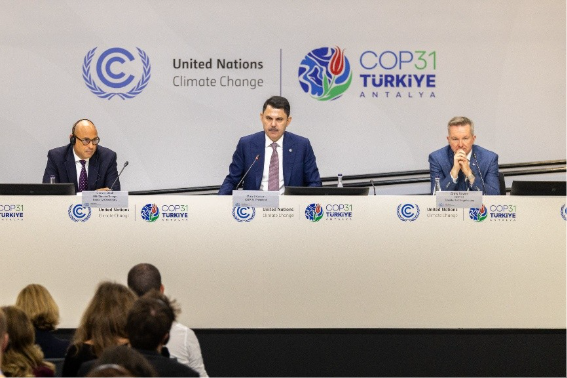
From left, UN Climate Change Executive Secretary Simon Stiell, COP31 President Murat Kurum, COP31 President of Negotiations Chris Bowen at press conference at COP31 in Antalya, Türkiye today. Credit: Kubilay Ciftci | UN Climate Change
Kurum: Energy insecurity is becoming an economic burden
COP31 President Murat Kurum placed the electrification agenda within the context of the global energy crisis. He argued that dependence on imported fuels exposes countries to price volatility and supply disruptions.
Providing a striking economic figure, Kurum said:
“Between March and August, fuel-importing countries faced around 330 billion dollars in additional costs.”
The figure, as presented by the COP31 President, highlights the potential economic consequences of dependence on imported energy. It raises an important question for developing countries. How can investment in domestic renewable energy and electricity infrastructure reduce exposure to international fuel-market shocks?
Kurum explained that the 35-by-35 initiative aims to increase electricity’s share of global final energy consumption. This share would rise from about 23% to 35% by 2035.
He also made clear that the Presidency wants the summit to be remembered for practical outcomes rather than announcements alone:
“We want to deliver a COP that allows us to leave Antalya saying, ‘Something changed in Antalya. We achieved results here. We delivered outcomes.’”
This is an important political commitment against which the summit’s performance can be assessed. The test is whether the announced targets are supported by national plans. They rely on accessible financing, measurable implementation, and benefits for communities.
Kurum also stressed that climate adaptation and loss and damage must remain central to the summit. Referring to the risk of exceeding the 1.5°C temperature threshold, he said:
“That is why we must never give up on the 1.5-degree goal. The Paris Agreement continues to guide us.”
He noted that the summit should address the extent of any temperature overshoot. It should also consider the overshoot’s duration and its impact on vulnerable populations.
Bowen: Electrification must accelerate and multilateral cooperation must deliver
Chris Bowen, COP31 President of Negotiations, emphasised the partnership between Türkiye and Australia and the importance of maintaining international cooperation at a time of multiple global crises.
He described the current period as one of significant pressure, citing cost-of-living challenges, energy-market instability, the growing electricity demands associated with artificial intelligence and worsening climate impacts.
His central message was that international cooperation remains essential:
“Countries working together is not only the best way, it is the only way the only way of dealing with climate change and the other crises countries are facing.”
On electrification, Bowen described the 35% target as a substantial acceleration from the current level. He said global electrification had increased from 17% in 2005 to 19% in 2015 and approximately 23% at present.
He argued that achieving 35% by 2035 would require more than a four-fold increase in the rate of electrification compared with the recent pace he described.
Bowen also revealed that the Presidency was consulting Parties on how electrification could be addressed in the final COP decision.
That point is particularly important. The 35-by-35 pledge is an Action Agenda initiative, but the Presidency’s consultations could determine whether electrification also receives recognition in the formal negotiated outcome. Whether countries agree to such language—and how specific it becomes—will be an important measure of political support.
From electrification to the fossil-fuel transition: the unresolved connection
Taken together, the three leaders’ statements provide a compelling argument for faster electrification. However, they also expose a central challenge facing COP31: expanding electricity use is not the same as completing a transition away from fossil fuels.
The climate impact of electrification depends on the energy sources used to generate electricity. If electricity demand increases while power systems remain heavily dependent on coal, oil and gas, the emissions benefits will be limited.
This makes the fossil-fuel transition roadmap presented by Brazil’s COP30 Presidency particularly relevant to the COP31 agenda. The roadmap calls for nationally appropriate pathways away from fossil-fuel dependence, while recognising different economic circumstances and development needs.
The question now is whether Türkiye and Australia can connect the 35-by-35 initiative with a credible continuation of the roadmap process. A coherent energy transition requires governments to expand clean electricity, strengthen grids and storage, reduce fossil-fuel dependence, support workers and communities, and mobilise adequate finance.
Africa’s question: Who will finance the transition, and who will benefit?
For Africa, the remarks from Antalya carry particular significance. The continent needs expanded electricity access, affordable energy, stronger grids, clean cooking solutions and investment that supports industrialisation and employment.
The proposed Electrify Now Finance Coalition, with the World Bank and African Development Bank expected to serve as inaugural co-chairs in 2027, creates an opportunity to connect the electrification agenda with African development priorities.
But the key details remain to be established: how much finance will be mobilised, when it will become available, what proportion will be concessional or grant-based, and whether underserved communities and countries with limited fiscal capacity will benefit.
The leaders’ emphasis on implementation should therefore be tested against practical outcomes. For African countries, the measure of success is not simply an increase in the global share of electricity consumption. It is whether households receive reliable power, whether businesses can operate at affordable costs, whether rural communities gain access, and whether electricity supports productive industries and decent employment.
The COP31 leaders have presented electrification as an answer to energy insecurity and climate pressures. The next challenge is to demonstrate that this transition can be clean, affordable and fair—and that it can move alongside a credible pathway away from fossil fuels.
The question for Antalya is no longer simply whether the world should electrify. It is whether governments can finance and deliver the transition in a way that protects the climate while expanding energy access and development opportunities for those who need them most.
The other energy debate: Australia and Türkiye face pressure to carry forward the fossil-fuel transition roadmap
While the COP31 Presidency is promoting the “Age of Electricity” through its 35-by-35 Global Electrification Pledge, another critical energy debate is unfolding in Antalya: whether the Australian and Turkish Presidencies will carry forward the process of transitioning away from fossil fuels initiated by Brazil during COP30.
The issue brings a major political and policy question into the heart of COP31. Can the world accelerate electrification without clearly addressing the continued production and consumption of coal, oil and gas? And will the new electricity ambition complement a credible fossil-fuel transition, or risk becoming a parallel initiative that leaves the underlying dependence on fossil fuels insufficiently addressed?
On 10 November, Brazil’s COP30 Presidency presented its Roadmap for Transitioning Away from Fossil Fuels in Energy Systems, in a Just, Orderly and Equitable Manner at a high-level event in Antalya. The presentation brought together climate envoys, UN leaders and representatives from developed and developing countries, including UN Secretary-General António Guterres and UNFCCC Executive Secretary Simon Stiell.
The roadmap is intended to help countries assess their dependence on fossil fuels and identify national pathways for moving towards cleaner energy systems. It considers three interconnected dimensions: energy demand, energy supply and the wider economy. It also recognises that countries have different economic structures, capacities, energy resources and starting points. Importantly, it is a voluntary initiative of the COP30 Presidency, not a negotiated UNFCCC decision or a legally binding commitment. The COP30 Presidency’s published roadmap describes a framework for national assessments and international cooperation, including a proposed collective action process extending through 2033.
UN Secretary-General António Guterres used the Antalya gathering to urge the current COP31 leadership to move beyond discussion and establish a practical continuation process. He argued that national pathways must reflect different circumstances while contributing to a shared global direction. As he put it:
“There is no one-size-fits-all transition. Countries have different levels of dependence, different capacities, and different starting points. But all pathways must lead in the same direction.”
He also emphasised that national action alone would be insufficient because energy markets are interconnected and demand and supply must be managed together.
In a further appeal to the COP31 leadership, Guterres said: “Now, here at COP31, we must move from discussing the transition to organising it, financing it and delivering it. Let us leave Antalya with clear next steps to advance this roadmap.” His intervention places responsibility on Türkiye and Australia to establish continuity between Brazil’s roadmap and the future work of the COP Presidencies. Carbon Brief’s reporting from the Antalya presentation records this appeal.
The Netherlands calls for political continuity and financial support
The Netherlands has emerged as one of the countries pressing for the roadmap process to continue. Having co-hosted the first international conference on transitioning away from fossil fuels with Colombia in Santa Marta in April 2026, the Dutch government has argued that COP31 should prioritise the transition and turn the emerging international process into practical national action.
The Santa Marta process brought together governments, civil society, businesses and researchers to examine how countries can overcome dependence on fossil-fuel production and consumption. It created an additional diplomatic and policy platform alongside the formal UN climate negotiations. The conference’s outcome report documents the discussions and calls for international cooperation.
The Netherlands has also announced new financial support intended to help countries develop national transition roadmaps through the NDC Partnership. The reported US$600 million figure should be treated as an announcement requiring further clarification: journalists should establish whether it represents new and additional funding, the full value of a broader funding package, or resources mobilised through several existing programmes. Its allocation, financing terms, implementation period and beneficiary countries also need to be confirmed before it is presented as finance already delivered.
Germany, France and the Netherlands have published national roadmaps or plans addressing the transition away from fossil fuels. Their approaches provide examples of how governments can translate international discussions into national policy, although their economic circumstances and energy systems differ considerably from those of developing countries.
More than 80 countries backed the roadmap idea but political agreement remains difficult
The roadmap process builds on the discussions at COP30 in Belém, where more than 80 countries were reported to have supported calls for a stronger international process on transitioning away from fossil fuels. However, opposition prevented the proposal from becoming a negotiated outcome in the final COP30 decision. Brazil subsequently developed its own voluntary roadmap under its Presidency rather than presenting it as a negotiated UNFCCC text. Carbon Brief’s COP30 outcome analysis provides context on the divisions and the support reported at Belém.
This distinction is important. The roadmap is not itself an agreement requiring countries to phase out fossil fuels by a particular date. It is a framework intended to help governments understand their dependence, identify options and develop nationally appropriate transition pathways. Its influence will therefore depend on whether governments use it, whether financial and technical support is made available, and whether the next COP Presidencies maintain a process for reviewing progress.
The challenge is particularly significant for developing countries whose economies depend on fossil-fuel exports, whose electricity systems rely on coal or gas, or whose populations still lack access to modern energy. A just and orderly transition must address energy access, affordability, employment, public revenues, industrial development and the needs of affected workers and communities.
Nigeria’s National Council on Climate Change representative, Omotenioye Majekodunmi, captured this development challenge in a statement at the event:
“As a developing country with significant energy resources, energy access challenges, and growing industrial ambitions, we must industrialize and decarbonize simultaneously.”
That message has particular relevance across Africa. The continent’s transition cannot be reduced to a simple instruction to stop using fossil fuels. It requires affordable alternatives, reliable electricity, investment in infrastructure, economic diversification and support for countries whose development and public finances are tied to existing energy systems.
The affordability test: clean energy must improve people’s lives
The fossil-fuel roadmap debate also raises a question that extends beyond emissions targets: will the transition make energy more affordable for ordinary people?
Alok Sharma, President of COP26, highlighted the importance of electricity-market reform and the experience of households facing rising energy costs. He said:
“The reality is that for many of them, they have not seen energy prices come down over the last years. They’ve actually seen them go up. […] That has to change.”
His intervention points to an important gap between the falling costs of some renewable technologies and the prices households actually pay for electricity. The benefits of cheaper generation do not automatically translate into lower consumer bills. Electricity-market structures, grid investment, taxation, financing costs, infrastructure and regulation all influence the final price.
This is a particularly important issue for Africa, where electricity affordability and reliability remain central to development. A transition that expands renewable capacity but fails to deliver affordable connections, dependable supply and access for low-income households will not fulfil its wider development promise.
The contradiction COP31 must address
The fossil-fuel roadmap debate is directly connected to the 35-by-35 Global Electrification Pledge announced by the COP31 Presidency. Both initiatives seek to accelerate the transformation of global energy systems, but they approach the challenge from different directions.
The electrification pledge aims to increase electricity’s share of final energy consumption from around 23% to 35% by 2035. The fossil-fuel roadmap addresses the broader process of reducing dependence on coal, oil and gas across energy demand, supply and national economies.
The two initiatives can reinforce each other—but only if the growth in electricity consumption is powered increasingly by clean energy and accompanied by a credible reduction in fossil-fuel dependence. If electrification increases while electricity generation remains heavily dependent on coal and gas, the climate benefits could be limited.
This is not merely a theoretical concern. Reports concerns that the proposed 35-by-35 pledge does not itself require all additional electricity to come from low-carbon sources, while some countries are pressing for stronger clean-energy language.
For the COP31 Presidencies, the challenge is to connect the two processes. This involves expanding electricity use, accelerating renewable generation, and strengthening grids and storage. It also requires reducing fossil-fuel dependence and ensuring that workers and vulnerable communities are supported.
The question facing Antalya is not simply whether the world can electrify faster. It asks whether governments can agree on organizing, financing, and implementing a fair transition away from fossil fuels. This must also ensure developing economies have resources to industrialize and expand energy access.
World leaders arrive in Antalya. The test is whether the summit links electrification ambition to a credible, financed path away from fossil fuels. It will show if leadership connects electrification goals to finance and inclusivity.
The two energy initiatives now confronting COP31 should not be treated as separate political achievements. The 35-by-35 pledge will be judged by whether it delivers affordable electricity powered increasingly by clean energy. Brazil’s fossil-fuel roadmap will be judged by whether countries turn its recommendations into credible national plans. Financing arrangements and measurable action will show the credibility of those plans. For Africa, both initiatives must address the same development priorities. They include reliable electricity, clean cooking, industrialisation, employment, affordable energy, and fair access to climate finance. The world may be entering an age of electricity. It must also deliver a just and practical pathway away from fossil fuels.
This story was produced as part of the COP31 Climate Change Media Partnership, a journalism fellowship organized by Internews’ Earth Journalism Network, Informed Earth and the Stanley Center for Peace and Security.
This story was produced as part of the COP31 Climate Change Media Partnership, a fellowship for journalists covering the UN climate talks.








